
THE ERODING REAR: THE CHINESE LD-8A ANTI-RADAR MISSILE, DEAD STEALTH, AND THE THREAT TO WESTERN HVAA ASSETS

Intelligence and Strategic Analysis Report
Author: Extrema Ratio — Open Source Intelligence on China Liminal Global Power
Prospect: U.S. / NATO Strategic & Defense Assessment
STRATEGIC PREFACE
In the current context of great-power competition in the Eastern Pacific, the evolution of the People's Republic of China's suppression and destruction of enemy air defenses (SEAD/DEAD) capabilities represents one of the most critical indicators of the doctrinal maturation of the People's Liberation Army Air Force (PLAAF). For decades, the deterrent architecture of NATO and the United States has hinged on the ability to operate high-value surveillance and command (HVAA) assets in rear areas considered safe from direct threats. However, the vector analysis of China's new tactical munitions requires a drastic revision of this paradigm.
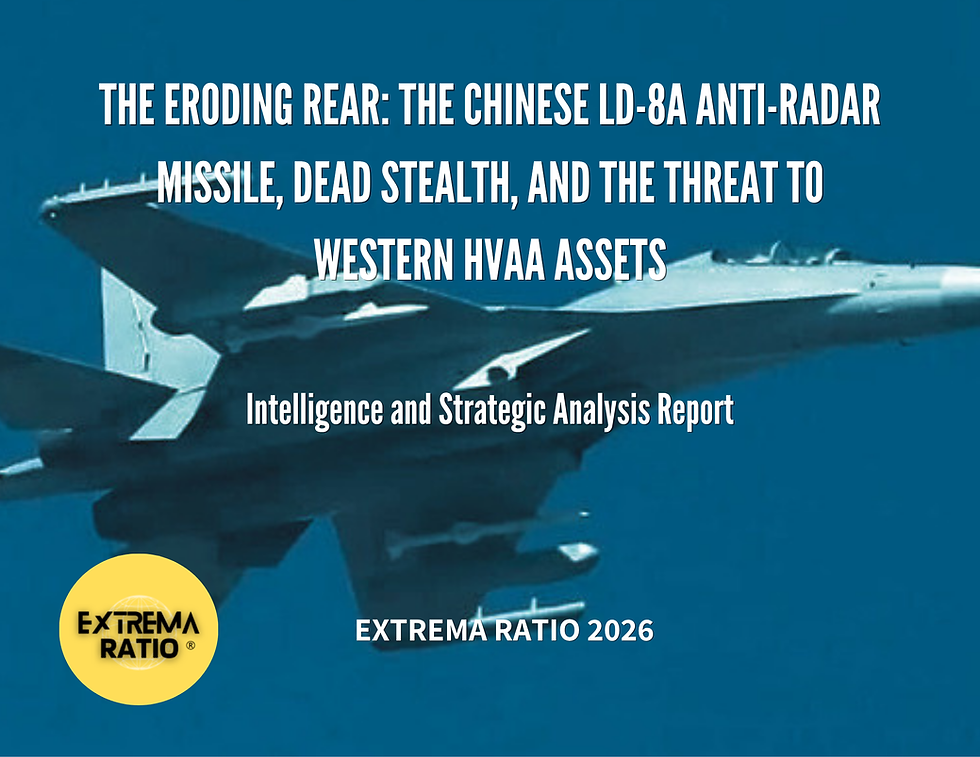
This intelligence report conducted by Extrema Ratio examines the operational integration of the lightweight anti-radar missile LD-8A traced progressively through primary sources and OSINT visual detections — from early display models at the Zhuhai Airshow (2024) to static trials on the J-35A fifth-generation fighter in Changchun (2025) and installation on real-world J-16D electronic warfare aircraft (2026) — the LD-8A represents much more than a simple tactical arsenal upgrade.
This analysis decodes the impact of this ammunition on the attack chain (kill-web) China, highlighting how the convergence of stealth technology, advanced electronic warfare and BeiDou satellite navigation systems is eroding the very concept of “rear area” and directly threatening the logistical and operational sustainability of Western air forces in the Indo-Pacific.
EXECUTIVE SUMMARY
Integration of the new lightweight anti-radar missile LD-8A under the wings of electronic warfare aircraft J-16 dand inside the weapons bays of fifth-generation stealth fightersJ-20andJ-35Amarks a turning point in the People's Liberation Army Air Force's (PLAAF) suppression and destruction of enemy air defenses (SEAD/DEAD) doctrine.
Developed from the architecture of the PL-15 long-range air-to-air missile, the LD-8A solves one of the most complex tactical dilemmas of modern air warfare: combining anti-radiation strike capabilities without sacrificing the stealth profile of the launch platform. From the perspective of US and NATO commanders, however, the threat transcends ground-based air defense alone. Thanks to a combination of broadband passive guidance, inertial/BeiDou navigation, and a two-way data link, the LD-8A possesses the inherent ability to engage high-powered airborne electromagnetic sources, directly jeopardizing AWACS/AEW&C aircraft. The traditional notion of a "safe rear" for allied C4ISR nodes has officially faded.
1. TECHNICAL AND DIMENSIONAL GENESIS: REVOLUTIONIZING THE INTERNAL LOAD
Historically, the Chinese Air Force's primary anti-radiation carrier has been the YJ-91 (derived from the Soviet/Russian Kh-31P missile). Although effective and supersonic, the YJ-91 weighed approximately 600 kg and had volumetric dimensions incompatible with the internal holds of fifth-generation fighters. Its use forced platforms such as the J-20 or J-35 to carry the ordnance on external underwing pylons, nullifying the aircraft's reduced radar signature (RCS).
The LD-8A breaks this engineering constraint through a massive feat of miniaturization and aerodynamic redesign:
Comparison Table of PLAAF Anti-Radiation and Air-to-Air Carriers
Parameter | YJ-91 (Legacy ARM) | PL-15 (AAM) | LD-8A (Next-Gen ARM) |
Length | ~4,7 m | 3,9 m | 3,2 m |
Diameter | 360 mm | 203 mm | 180 mm |
Total weight | ~600 kg | 210 kg | 130 kg |
J-20/J-35 Housing | External Only (No Stealth) | Internal Hold | Internal Hold (Full Stealth) |
Operational Range | ~120 km | 200+ km | 70 – 160 km (up to 200 km) |
Guidance System | Single-band Passive Radar | AESA Active + INS/Sat | Passive Broadband + INS/BeiDou + Datalink |
Weighing only 130 kg and with a length of just 3.2 metres, the LD-8A fits perfectly within the volumetric parameters of the main weapons bay of the J-35A and of the J-20. This allows Chinese fighters to penetrate enemy surveillance radar in total stealth mode, engaging IADS (Integrated Air Defense System) nodes before being detected.
2. THE "KILL-WEB" ARCHITECTURE: SYNERGY BETWEEN J-16D, J-35A AND GUIDANCE SYSTEMS
The evolution of the LD-8A — first observed in static displays at Zhuhai (2024) and Changchun (2025) and subsequently integrated onto operational J-16D aircraft (2026) — reveals a profound maturation of the PLAAF's integrated engagement network.
The Dual Attack Matrix (Soft-Kill + Hard-Kill)
The EW Dedicated Platform (J-16D): The underwing integration of the LD-8A on the J-16D creates a closed electromagnetic suppression system. The aircraft's electronic warfare pods detect, classify, and geolocate enemy emissions; the onboard system inputs the coordinates into the LD-8A missile, which is launched for physical destruction.hard-kill), while the pods keep the disturbance active (soft-kill).
Stealth Penetrator Vectors (J-20 / J-35A): Operating in highly contested environments (Anti-Access/Area Denial- A2/AD), stealth fighters can act as silent advanced sensors. By receiving the enemy's emissions grid via data link, they can launch the LD-8A from the internal cargo bay without emitting radar signals of their own.
Target Radar Shutdown Resilience
The LD-8A's passive seeker is integrated with a satellite-updated inertial navigation unit (INS). BeiDou and connected via a two-way data link. If the enemy radar operator detects the threat and turns off the transmitter, the LD-8A doesn't lose track: it continues its course towards the last known coordinates via satellite/inertial guidance, reactivating the passive search in the terminal phase to engage the target as soon as it attempts to resume transmissions or via the residual signature.
3. FROM SEAD TO COUNTER-HVAA: THE NEUTRALIZATION OF ALLIED AWACS
The most critical feature of the LD-8A for Pentagon and NATO planners lies in its versatility for cross-domain deployment. Although conceived primarily as a SEAD weapon against ground radar stations (such as Patriot or NASAMS systems), the nature of its sensor makes it an ideal candidate for the role of Counter-HVAA (High-Value Airborne Asset).
"High-power radars installed on airborne platforms such as the E-3G Sentry or the new E-7A Wedgetail constitute the most powerful and visible source of electromagnetic radiation in the entire theater of operations. For a missile with a highly sensitive passive seeker and integrated BeiDou guidance, an operational AWACS is nothing more than a beacon in the night."
The Tactical Scenario in the Pacific
In a hypothetical engagement in the Eastern Pacific, a J-20 or J-35A stealth fighter, operating in radio silence, could receive via data-link the approximate vector position of an allied AEW&C platform 150 km away.
The LD-8A is released from the internal cargo hold at high altitude and supersonic speed (extending the maximum range to 200 km).
The missile flies towards the target area guided by BeiDou.
In the final phase, the passive seeker locks onto the powerful scanning frequencies of the AWACS.
The enemy command platform's reaction window is reduced to a few seconds: turning off the primary radar means blinding all allied tactical assets in the area; keeping it on guarantees the missile's impact.
4. STRATEGIC IMPLICATIONS AND COMPARISON WITH US/NATO PROGRAMS
The development of the LD-8A demonstrates that China has filled one of its last doctrinal gaps in the field of precision aerial munitions, aligning itself with and in some respects challenging state-of-the-art Western programs, such as the AGM-88G AARGM-ER American and conceptual designs for Anti-Aircraft Emission Missiles (AESM).
Operational Impacts for Western Forces
Strategic Depth Erosion:The ability to launch anti-radiation weapons from stealth holds eliminates the safety distance for airborne command and control centers, naval radar stations, and field IADS sites. There is no longer a clear dividing line between "front" and "rear."
Economic and Logistical Saturation:A missile weighing just 130 kg and costing less than complex cruise missiles allows China to carry out massive saturation attacks against allied sensor infrastructure.
Redefining the C4ISR Survival Doctrine:NATO's reliance on large-scale airborne surveillance radar (AWACS) platforms is being severely tested. The existence of the LD-8A accelerates the need for the United States to shift toward distributed surveillance architectures based on satellite constellations and large-scale, distributed tactical drones.
CONCLUSION
The LD-8A is not simply an addition to the PLAAF's tactical arsenal, but the symbol of a paradigm shift: the perfect fusion of stealth technology, advanced electronic warfare, and precision kinetic saturation. China's demonstrated ability to miniaturize anti-radiation vectors for internal mounting on fifth-generation fighters dramatically reduces Western air defense response times and threatens the very foundation of NATO's information superiority in the Indo-Pacific.
About us: Extrema Ratio provides geopolitical and military analysis and consulting, specializing in open-source intelligence (OSINT) on Beijing's global strategy. Our analyses decode Chinese Liminal warfare; this strategy lies in that "no man's land" where the distinction between peace and war becomes almost invisible. Our analyses are cited by the Italian Department of Information Security (DIS), the United States Congress, and Stanford University.


All right reserved.
Commenti